Introduction
Quick answer: Filing Form 5472 for a foreign-owned LLC involves five steps: confirming eligibility, submitting your LLC and transaction details, having a tax professional prepare the pro forma Form 1120 and Form 5472, paying only once the filing is ready, and reviewing and signing before submission to the IRS by online fax. No special software or IRS account is required on your end.
If you own a foreign-owned US LLC, filing Form 5472 can feel like one more unfamiliar hurdle in an already unfamiliar tax system. The good news: when you understand what's actually involved, the process is a routine annual task rather than a legal minefield.
This guide walks through exactly how to file Form 5472 — what information you'll need, the steps involved from start to finish, and why the pro forma Form 1120 that accompanies it matters just as much as the form itself. You'll also see where professional preparation makes a measurable difference, particularly when $25,000 penalties are on the line for errors or missed deadlines.
If you haven't confirmed whether your LLC actually needs to file, it's worth checking that first. Our complete Form 5472 filing requirements guide covers eligibility, deadlines, and penalties in full. This guide assumes you already know filing applies to you and want to understand the mechanics of getting it done.
What information do you need to file Form 5472?
Before any preparation can begin, you'll need to gather a handful of details about your LLC and your activity with it during the tax year. Having these ready in advance speeds up the entire process considerably.
You'll typically need:
- LLC formation details. The state of formation, formation date, and registered business name.
- Your EIN. Form 5472 cannot be filed without an Employer Identification Number assigned to the LLC.
- Ownership information. Details confirming you (or the foreign entity involved) as the owner, including your country of residence or incorporation.
- A summary of reportable transactions. Every contribution, distribution, formation cost, or personally paid expense connected to the LLC during the year.
That last category trips up more owners than any other. Reportable transactions aren't limited to large transfers — a $75 registered agent fee paid from your personal account counts the same as a $50,000 capital contribution. If you're unsure what qualifies, it's worth reviewing the transaction types in detail before you start gathering records, so nothing gets left out of your filing.
What are the steps to file Form 5472?
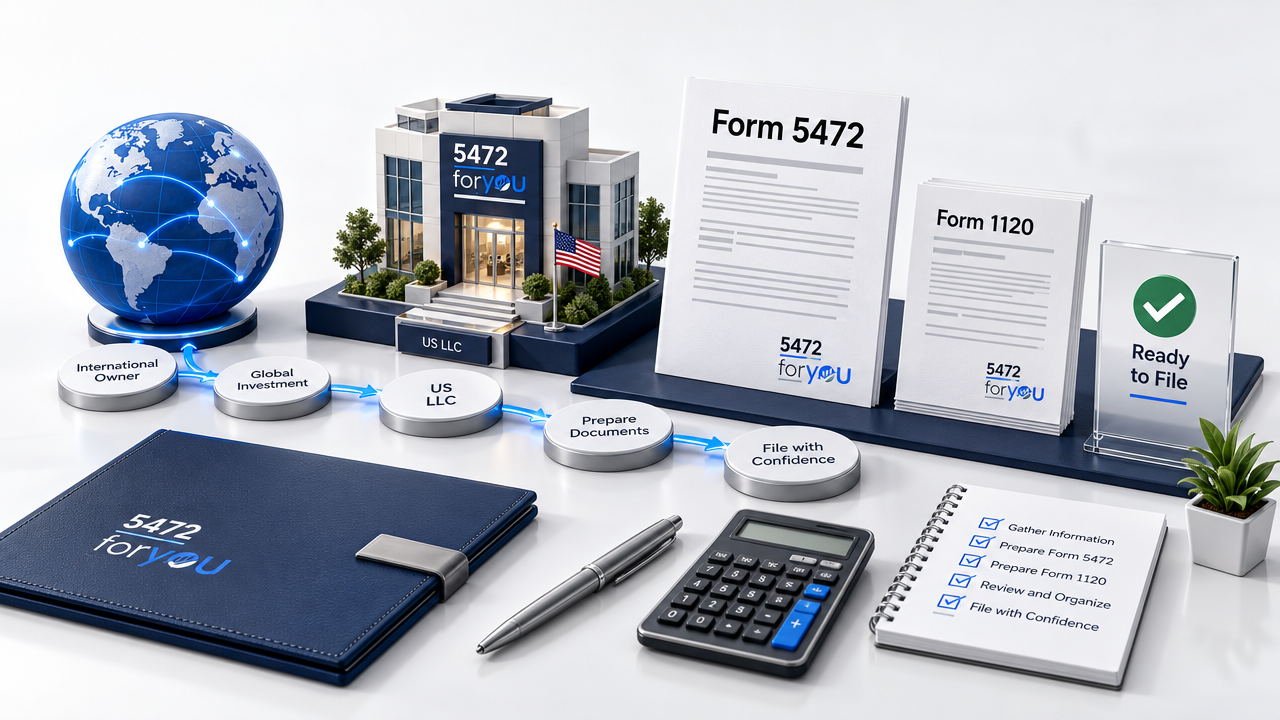
Filing Form 5472 correctly comes down to five sequential steps. Here's what each one actually involves.
Step 1: Confirm your filing eligibility
Before anything else, confirm that your LLC meets the criteria for filing: it's a US LLC, it's foreign-owned, and it had at least one reportable transaction during the tax year. A short eligibility questionnaire is usually enough to settle this. Skipping this step is where many owners either file unnecessarily or, more often, assume they're exempt when they're not.
Step 2: Submit your LLC and transaction information
Once eligibility is confirmed, you'll provide the formation details, EIN, ownership structure, and transaction summary outlined above. This is typically done through a secure upload process rather than back-and-forth email, which keeps sensitive information like EINs and ownership details protected.
Step 3: Let a tax professional prepare your filing
This is where the real work happens. A tax professional reviews your submitted information, prepares your Form 5472, and completes the accompanying pro forma Form 1120. This isn't a software-generated PDF — it's a return prepared and reviewed by someone who understands how foreign ownership interacts with US corporate reporting rules.
Step 4: Pay once your filing is ready
Rather than charging upfront, a properly structured Form 5472 service will prepare your filing first and only request payment once it's complete. You're paying for a finished, reviewed filing, not a promise of future work. At 5472forYOU, Standard Filing is $199 and Expert Filing — which includes a dedicated case review and a second expert review — is $299.
Step 5: Review, sign, and submit
Once payment is made, you review the completed Form 5472 for accuracy and electronically sign the pro forma Form 1120. From there, the filing is submitted to the IRS using the appropriate online fax process, and you receive confirmation that it was transmitted.
Mirroring this exact sequence is deliberate. Each step exists to catch a different kind of error, whether that's incomplete information, missing transactions, or an unsigned form at the finish line. Rushing or skipping a step is usually where mistakes creep in.
Why does the pro forma Form 1120 matter for your 5472 filing?
Form 5472 is rarely filed alone. For foreign-owned disregarded entities — the classification that applies to most single-member LLCs — Form 5472 is generally submitted attached to a pro forma Form 1120, even though the LLC itself doesn't owe corporate income tax.
The pro forma Form 1120 acts as a cover document, giving the IRS the structure it needs to process Form 5472 correctly. Without it, your Form 5472 filing is incomplete, even if the form itself is filled out perfectly. This is one of the most common gaps in self-prepared filings: owners complete Form 5472 but either omit the pro forma 1120 entirely or fill it out incorrectly, since it isn't something most LLC owners have ever encountered before.
For a deeper look at how these two forms relate to each other and why one doesn't substitute for the other, see our guide on Form 5472 and Form 1120 together.
How is Form 5472 actually submitted to the IRS?
Once your Form 5472 and pro forma Form 1120 are reviewed and signed, submission happens through online fax. This might sound outdated, but it's a standard, accepted method for this particular filing, and it doesn't require you to have an IRS e-file account or any special software.
After submission, you should receive confirmation and documentation proving the filing was transmitted. Keep this record. If the IRS ever contacts you about your filing status, this confirmation is your evidence that the deadline was met.
Speaking of deadlines: Form 5472 is generally due by April 15 following the end of the tax year, filed alongside the pro forma Form 1120. If that date is approaching and you haven't started, timing becomes a real factor in how smoothly the process goes. Our Form 5472 deadline guide covers extension options and what to do if you're already behind.
Should you work with a professional or file Form 5472 yourself?
Form 5472 can technically be filed using DIY software or by filling out the paper form yourself. But a few considerations are worth weighing before you decide which route fits your situation.
Choose a professional-prepared filing if accuracy and accountability matter more than saving a small amount upfront. A tax professional identified by a PTIN (Preparer Tax Identification Number) stands behind the filing. At 5472forYOU, your Form 5472 and pro forma Form 1120 are prepared and reviewed by Michal Zacik, a US tax professional with more than 10 years of corporate tax experience and over 7 years focused specifically on nonresident taxation. His PTIN is included on the pro forma Form 1120, which many automated or template-based services simply don't offer — leaving no identified preparer standing behind the work.
Choose DIY software if your situation is extremely simple and you're comfortable researching every requirement independently. This path works for some owners, but it also means you're responsible for correctly identifying every reportable transaction, completing the pro forma Form 1120 without guidance, and managing submission yourself. Given that the penalty for a late or incorrect Form 5472 starts at $25,000, the margin for error is thin.
There's also the question of what happens if something goes wrong. A reasonable cause statement — used to request penalty relief for late filings — is included at no additional charge with professional preparation when the facts support one. The IRS makes the final call on whether relief is granted, but having a professionally drafted statement gives your case a stronger foundation than attempting one yourself after the fact.
Get your Form 5472 filed without the guesswork Filing Form 5472 isn't inherently complicated. It becomes risky when it's handled by someone unfamiliar with how the form interacts with the pro forma Form 1120, or when reportable transactions go unidentified before the deadline passes. Following the five-step process outlined here — confirming eligibility, submitting your details, having your filing professionally prepared, paying only once it's ready, and reviewing before submission — keeps the process predictable from start to finish. With no upfront payment required, you see the completed, professionally reviewed work before any money changes hands.
Start your filing →Frequently asked questions
Sources
- IRS — Instructions for Form 5472
- IRS — Instructions for Form 1120
- IRS — Employer identification number
- IRS — Single member limited liability companies
Rules can change and many situations have exceptions. Where guidance is nuanced, the IRS instructions above control.